
I’ve been reviewing Ecosia on this site since 2018, and the question I get most often in the comments isn’t about trees. It’s some version of: “Should I just use DuckDuckGo instead?” So I decided to give DuckDuckGo the same treatment I gave Ecosia, and then go further.
Instead of repeating DuckDuckGo’s marketing, I tested it. I ran the same searches on DuckDuckGo, Google and Bing in a fresh browser and counted every cookie each one set. I captured what DuckDuckGo’s own page sends back home, and I decoded a real DuckDuckGo ad link to see exactly where your click goes. I also compared DuckDuckGo’s results against Bing’s across 15 searches to answer the “isn’t it just Bing?” question with numbers. Finally, I dug into who runs the company, who funded it, how it makes money, and every controversy I could find.
The short answer: yes, DuckDuckGo is legit, and it’s one of the safest mainstream search engines you can use. In my tests, a search on DuckDuckGo set zero cookies, compared with 5 on Google and 25 on Bing. But it isn’t magic. Most of its results come from Microsoft’s Bing, clicking one of its ads passes that click through Microsoft, and its strongest privacy promises have never been independently audited. Below is everything I found, good and bad, so you can decide for yourself.
- What is DuckDuckGo?
- Who is behind DuckDuckGo?
- Is DuckDuckGo legit or a scam?
- Is DuckDuckGo safe? I tested it
- Is DuckDuckGo just Bing?
- How does DuckDuckGo make money?
- The controversies: both sides
- DuckDuckGo vs Google
- DuckDuckGo vs Ecosia, Brave and Startpage
- The browser, Duck.ai and the subscription
- How to make DuckDuckGo even more private
- My verdict
- DuckDuckGo FAQ
What is DuckDuckGo?
DuckDuckGo is a search engine (and now a web browser, an AI chat app and a privacy subscription) built around one promise, which is also the headline of its privacy policy: “We don’t track you.” It doesn’t keep your search history, doesn’t build a profile on you, and shows ads based on what you just searched for instead of everything it knows about you.
It’s not a tiny side project anymore. According to its own About page, DuckDuckGo handles around 3 billion searches a month, gets 9 million app downloads a month, and has 335 employees spread across more than 15 countries. It’s been the default search engine in the Tor Browser since 2016 and is a built-in option in Safari, Firefox, Chrome and Edge.
| Founded | September 25, 2008, by Gabriel Weinberg |
|---|---|
| Headquarters | Paoli, Pennsylvania, USA (fully remote team) |
| Ownership | Private company, independent; not owned by Google or Microsoft |
| Searches | About 3 billion a month |
| US market share | 1.75% (StatCounter, September 2026) |
| Revenue | “Above $100 million a year” since at least 2021; profitable since 2014 (company statements) |
| Main results source | Microsoft Bing, plus its own crawler and specialist sources |
| Donations | $8.05 million to privacy and digital-rights groups since 2011 |
Who is behind DuckDuckGo?
A big part of trusting a privacy company is trusting the people running it, so I looked into them the same way I did with Ecosia’s team. (For the full ownership story, see who owns DuckDuckGo.)
Gabriel Weinberg, founder and CEO
Gabriel Weinberg studied physics (2001) and technology policy (2005) at MIT. Before DuckDuckGo, he built a social networking site called the Names Database, which United Online’s Classmates bought in March 2006 for about $10 million in cash. That detail matters: when he started DuckDuckGo he didn’t need investors, and he ran it alone out of his basement in suburban Philadelphia for years. He was a stay-at-home dad with a toddler at the time.
He launched DuckDuckGo on September 25, 2008, and self-funded it until late 2011. He had planned to put off raising money “perhaps forever,” he told TechCrunch. In January 2011 he bought a single billboard in Google’s backyard in San Francisco that read “Google tracks you. We don’t.” That one ad basically became the company’s identity.
Outside DuckDuckGo, he co-wrote two well-known business books: Traction (with Justin Mares), a startup marketing guide, and Super Thinking: The Big Book of Mental Models (2019) with his wife, Lauren McCann. He also writes a personal Substack about tech, AI and policy.
What stands out to me is his public record. Weinberg has testified to the US Senate Judiciary Committee on privacy law (2019) and was a witness in the US government’s antitrust case against Google in September 2023. There he testified that switching your default search engine across all your devices can take 30 to 50 steps, and that DuckDuckGo held roughly 2.5% of US search. He has been fighting Google over default search deals and choice screens for years. As of October 2026 he is still CEO, with no leadership change.
The investors
DuckDuckGo has taken surprisingly little outside money for a company its size, and most of it went to early employees and investors cashing out shares rather than into the business:
- 2011: Union Square Ventures (early investor in Twitter and Tumblr) led its first round. USV partner Brad Burnham joined the board. USV’s Fred Wilson said the bet was on privacy-minded users, not on beating Google.
- 2018: $10 million from OMERS Ventures, the venture arm of a Canadian public pension fund. DuckDuckGo initially turned it down because it didn’t need the cash.
- 2020: More than $100 million, mostly secondary, from OMERS, Thrive Capital, GP Bullhound and individual investors including Tim Berners-Lee (inventor of the World Wide Web) and WhatsApp co-founder Brian Acton.
Other leaders include Kamyl Bazbaz, its chief communications and policy officer, who testified at a Senate antitrust hearing in 2025. In total, TechCrunch reported in 2024 that DuckDuckGo had raised about $180 million, “a fair chunk of it” secondary. No investor is Chinese, Russian, Google or Microsoft.
Is DuckDuckGo legit or a scam?
DuckDuckGo is legit. Here’s what convinces me:
- It has a real, profitable business. It says it has been profitable since 2014, and its revenue has been reported above $100 million a year since at least 2021. It doesn’t need to secretly sell your data to survive. Its ads alone pay the bills (more on that below).
- It has a long public track record. It has 18 years of operating history, sworn court testimony, Senate testimony, and well-known institutional investors.
- It gives money away. Every year since 2011 it has donated to privacy and digital-rights organizations: $1.1 million in 2025 alone and $8.05 million in total. Recipients include the Electronic Frontier Foundation, Signal, Public Knowledge and ARTICLE 19.
- Its code is public. DuckDuckGo has 127 public repositories on GitHub, including its browsers and tracker blocklists, so anyone can inspect how its apps actually work.
“Isn’t DuckDuckGo owned by Google?”
No. This myth comes from the domain duck.com. Google happened to own it (it came with a 2010 acquisition), and for years duck.com redirected to Google. Google handed the domain over to DuckDuckGo in December 2018. That was a domain transfer, not a company sale. DuckDuckGo is still independent and has spent the last decade fighting Google in court and in front of regulators.
“Is it a CIA honeypot / owned by China?”
I couldn’t find any credible evidence for either claim. The honeypot idea seems to come from the fact that DuckDuckGo’s traffic doubled right after Edward Snowden’s 2013 surveillance leaks. Its ownership and investors are public, and none are Chinese. The fair point buried in these theories is that DuckDuckGo is a US company subject to US law, so it can be ordered to hand over data. Its defense is that it has nothing useful to hand over. Its privacy policy says it’s “not possible for us to provide search, chat, or browsing histories linked to you,” because it doesn’t store them.
Is DuckDuckGo safe? I tested it
“Is DuckDuckGo safe” is the single biggest question people search about it, so I didn’t want to just quote the privacy policy. (I’ve since expanded this into a dedicated guide: Is DuckDuckGo safe?) On October 9, 2026, I ran a simple, repeatable test. I opened a brand-new Chrome profile for each search engine (no history, no account, no cookies), searched for “best hiking boots” without clicking any consent banners, and recorded every cookie and every network request using Chrome’s developer tools.
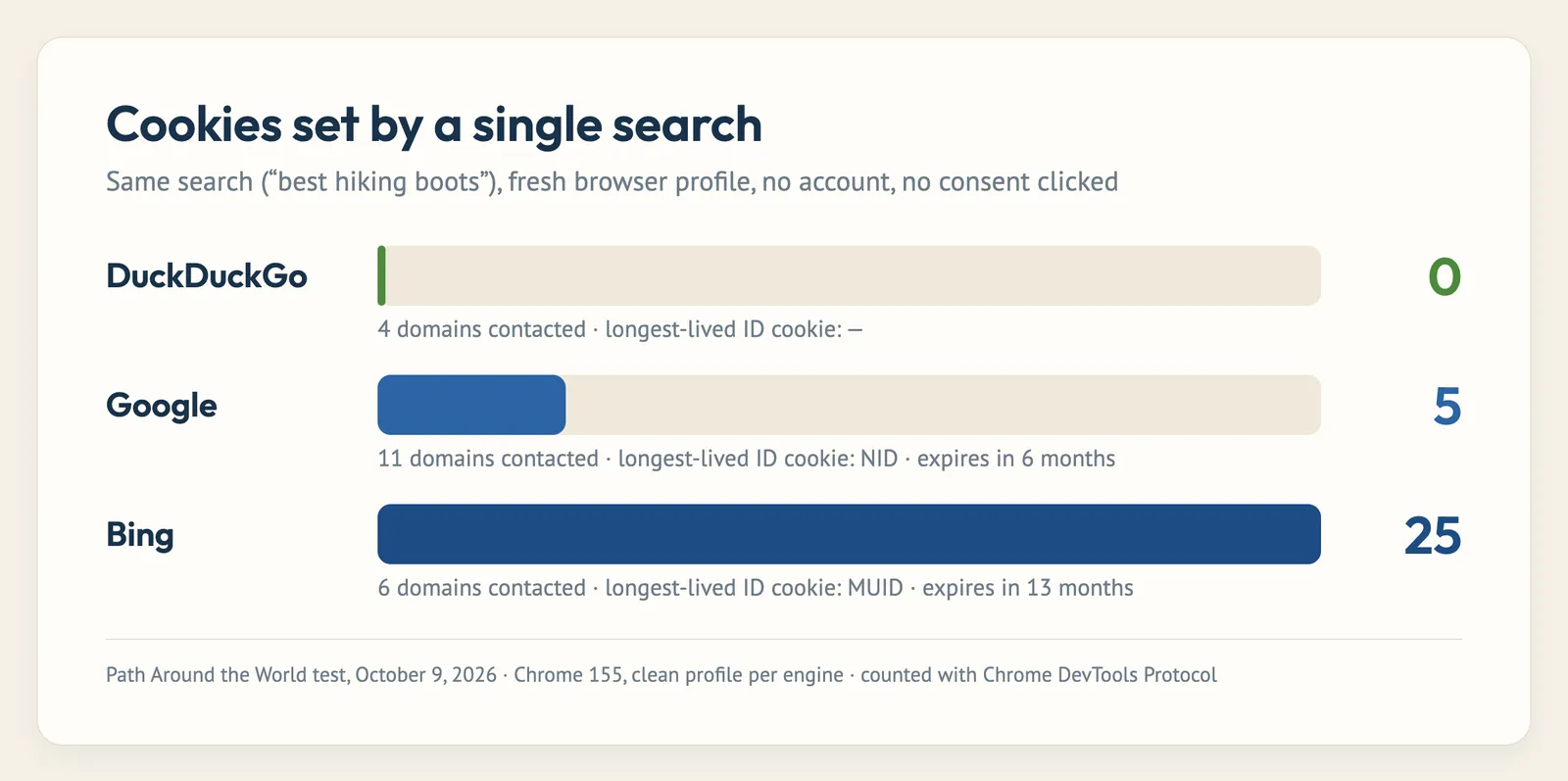
The results were stark:
- DuckDuckGo set zero cookies. Every request went to DuckDuckGo’s own domains (duckduckgo.com and three of its subdomains).
- Google set 5 cookies, including its
NIDidentifier cookie that lasts six months. The page also loaded Google Tag Manager and Google’s ad services. - Bing set 25 cookies, including a
MUIDmachine ID that lasts 13 months. It also contacted Microsoft’s login servers even though I never signed in.
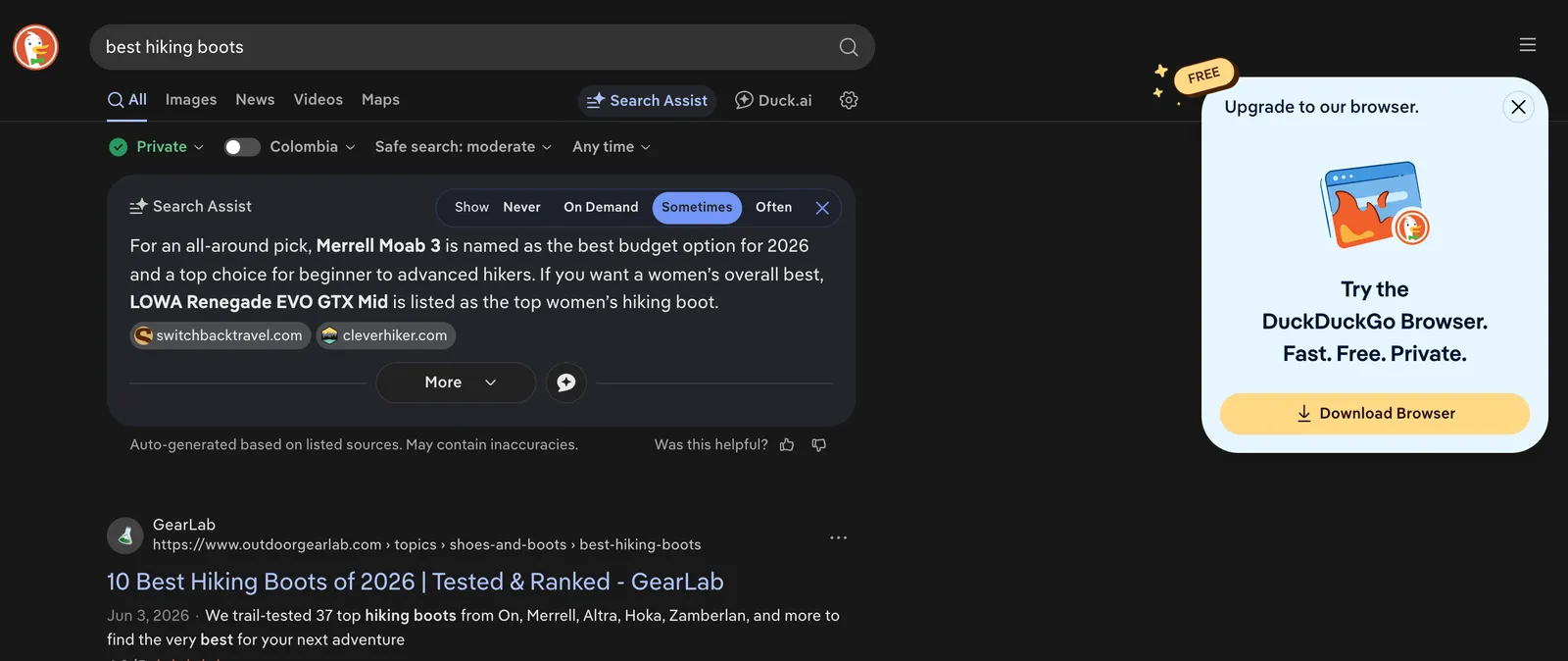
Notice the green “Private” label and the region chip in the screenshot above. DuckDuckGo detected I was in Colombia (where I was testing from) to localize results, but it does that on the fly from your IP address without storing it. You can also turn regional results off.
What DuckDuckGo does send home
To be fair, I also looked for anything DuckDuckGo sends that people might not expect, and I found it. After each search, the page sends small analytics requests to improving.duckduckgo.com. Here’s a real one I captured:
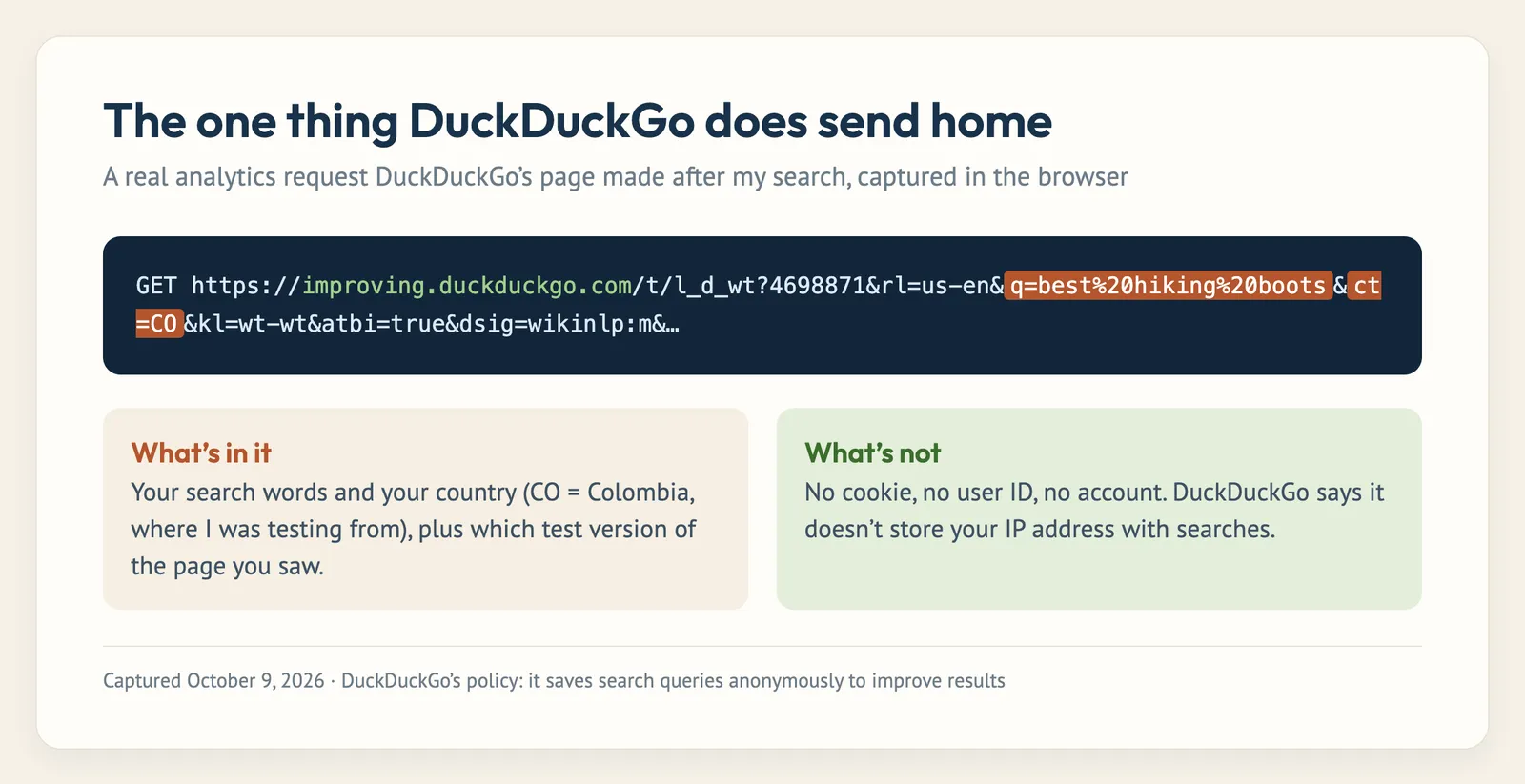
It contains my search words (“best hiking boots”), my country (CO for Colombia), and which version of the page I was shown (DuckDuckGo constantly A/B tests its design). That might look alarming at first. But it lines up with the privacy policy, which says DuckDuckGo saves search queries anonymously to improve results. What it doesn’t include matters more: no cookie, no user ID, no account, nothing that ties this search to my previous searches. DuckDuckGo says it doesn’t store your IP address alongside your searches. A search engine that knows “someone in Colombia searched for hiking boots” is very different from one that knows “this specific person has searched for hiking boots, a medical condition and a divorce lawyer this month.”
The catch: clicking an ad
This is where DuckDuckGo’s privacy has a real hole, and it’s worth understanding. I took the actual link behind the first ad on my results page and decoded it:
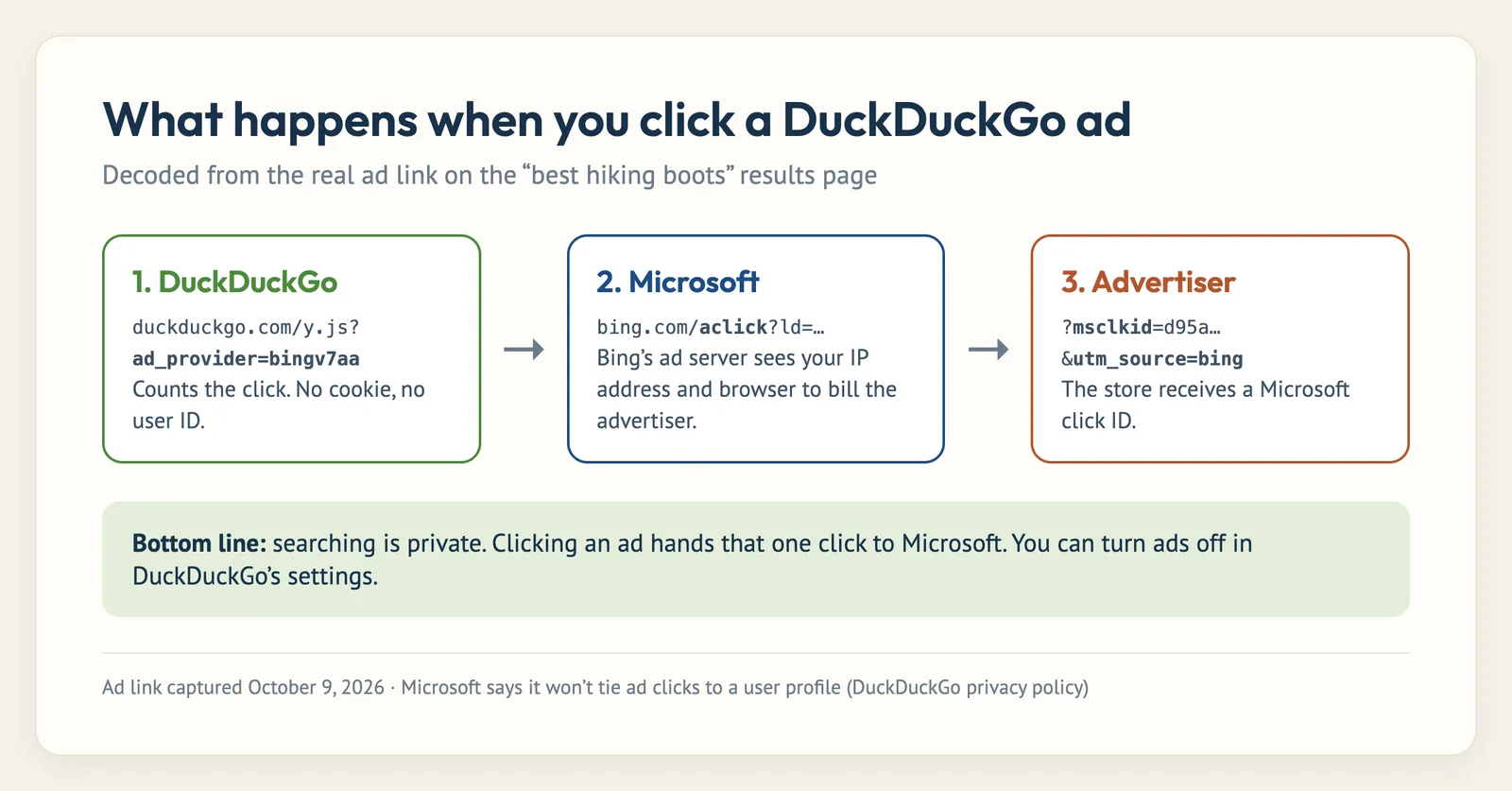
The ad link goes to DuckDuckGo first, then through Microsoft’s ad server at bing.com/aclick, and then to the advertiser with a Microsoft click ID (msclkid) attached. DuckDuckGo is upfront about this in its own help pages. When you click a Microsoft ad, “Microsoft Advertising will use your full IP address and user-agent string” to process the click and bill the advertiser. Microsoft has committed not to tie your ad clicks to a user profile.
An academic study presented at the 2023 ACM Internet Measurement Conference (Chouaki, Goga, Haddadi and Snyder) confirmed what I saw. Every DuckDuckGo ad click they tested went through Bing redirects, and Bing set identifier cookies on 95% of those click paths. The researchers found no identifiers set by DuckDuckGo itself, but concluded Microsoft could track users through ad clicks. DuckDuckGo also notes that after you click an ad, it allows Microsoft’s conversion tracking (bat.bing.com) on the advertiser’s site, with cookies that expire after 7 days.
The practical takeaway: searching on DuckDuckGo is private. Clicking an ad is about as private as clicking an ad on Bing. If that bothers you, scroll past the results marked “Ad,” or turn ads off entirely in DuckDuckGo’s settings.
Is DuckDuckGo secure?
- Encrypted: every search uses HTTPS, so your internet provider and Wi-Fi owner can see you’re using DuckDuckGo but not what you searched for.
- No known breaches: I couldn’t find any reported breach of DuckDuckGo user data. That makes sense because it keeps very little user data to breach.
- Bugs happen: its iOS browser had an address-bar spoofing vulnerability in 2021 (CVE-2021-44683) that was fixed. That’s normal for any browser, but it shows “private” isn’t the same as “bulletproof.”
- Tor support: it runs an official .onion address for people who need to hide their IP address even from DuckDuckGo.
The honest limitation: you’re trusting a policy
My browser tests can show what DuckDuckGo does in your browser. They can’t show what happens on its servers. I couldn’t find any independent audit confirming that DuckDuckGo deletes what it says it deletes. Even Privacy Guides, which recommends DuckDuckGo, points out that “there is no guarantee that these privacy policies are honored.” So DuckDuckGo’s privacy rests on its policy, its track record, and the fact that lying would destroy its entire business. That’s more than most companies give you, but it’s still trust, not proof.
Is DuckDuckGo just Bing?
You’ll often see DuckDuckGo dismissed as “Bing with a duck on it.” DuckDuckGo openly says its traditional web links are “largely” sourced from Bing, along with its own web crawler (DuckDuckBot), Apple Maps for local results, Wikipedia and other specialist sources. But how much is “largely”? I measured it.
I ran 15 everyday searches (recipes, health, travel, tech, news) on DuckDuckGo and Bing with US-English settings, and checked how many of DuckDuckGo’s top 10 results also appeared in Bing’s top 10:
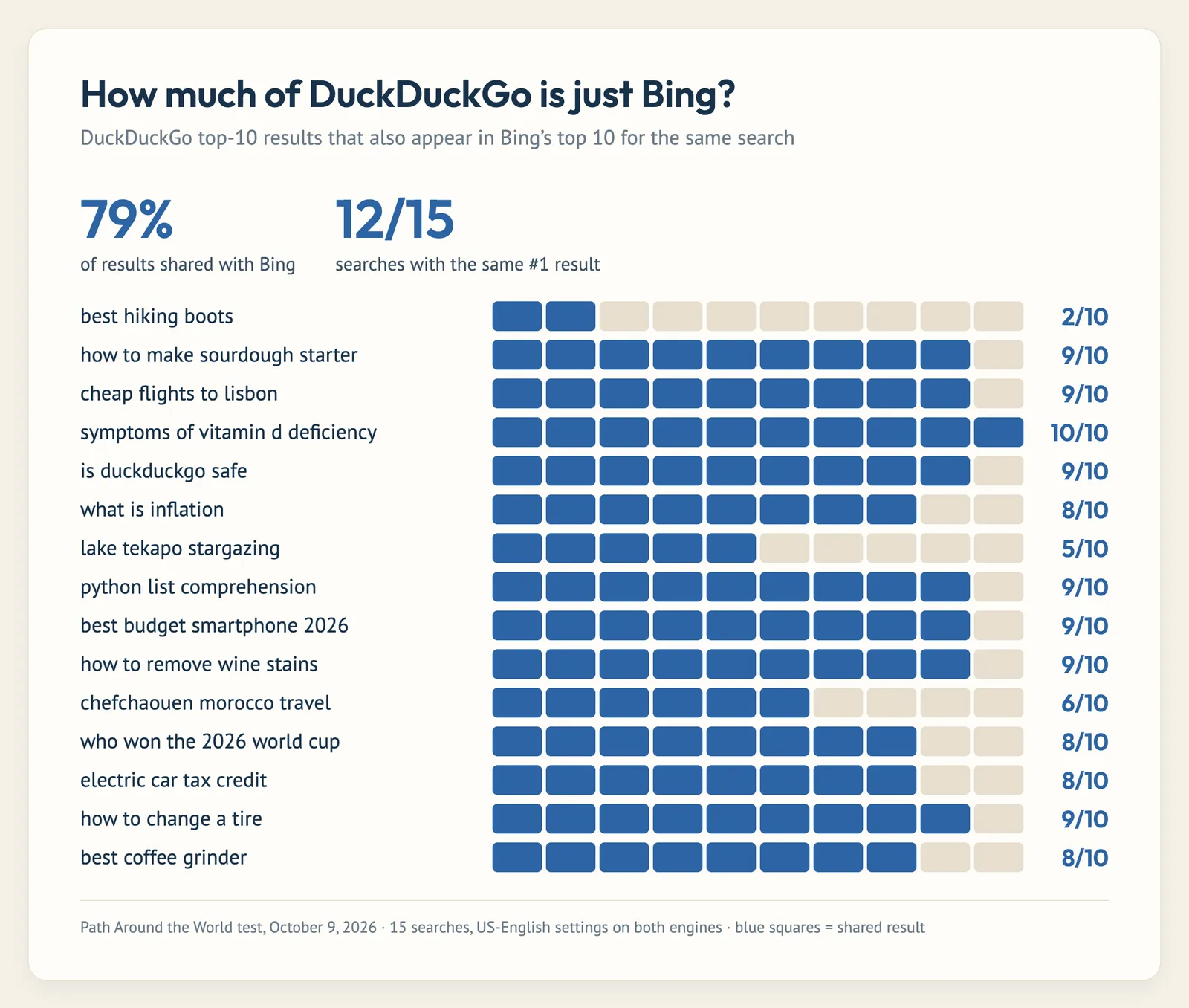
79% of DuckDuckGo’s results were also in Bing’s top 10, and the #1 result matched in 12 of 15 searches. So yes, DuckDuckGo is mostly Bing under the hood. But it isn’t a carbon copy. It re-ranks and mixes in other sources, and for “best hiking boots” only 2 of its 10 results matched Bing’s.
Is that a bad thing? Not really. Building an index of the whole web costs billions, and almost every alternative search engine rents one. Ecosia uses Google and Bing, Startpage uses Google, and Yahoo uses Bing. What you’re paying DuckDuckGo for is privacy, not a different index. The real downside is dependence: when Bing’s API went down on May 23, 2024, DuckDuckGo (and Ecosia) went down with it for hours.
How does DuckDuckGo make money?
If DuckDuckGo doesn’t sell your data, how does a 335-person company pay for itself? Through three main sources:
- Search ads (the big one). When you search “best hiking boots,” DuckDuckGo shows ads for hiking boots. It doesn’t need to know anything about you to do that; your search tells it what you want right now. These are called contextual ads, and they were the norm before Google and Facebook made tracking-based ads the industry standard. Most of DuckDuckGo’s ads come from Microsoft Advertising, and it also has ad partnerships with Tripadvisor and Yelp. A 2024 court filing described Microsoft’s US search ads as its main source of operating revenue. Each time someone clicks an ad, DuckDuckGo gets a cut.
- Affiliate links (historically). DuckDuckGo used to earn small commissions from non-tracking affiliate programs such as Amazon and eBay. Its current help pages no longer mention them, so this looks like a minor or discontinued source today.
- The DuckDuckGo subscription. Since April 2024 it has sold a paid plan (originally called Privacy Pro). It now has two tiers. Plus ($9.99/month or about $100/year) includes a VPN, Personal Information Removal (US only), Identity Theft Restoration and advanced Duck.ai models. Pro ($19.99/month) adds the top AI models and higher usage limits.
Revenue has been reported above $100 million a year since at least 2021, and the company has said it has been profitable since 2014. I break all of this down in how DuckDuckGo makes money. Since DuckDuckGo is private, it doesn’t publish audited financials the way Ecosia publishes monthly reports. That’s one area where Ecosia is more transparent. (If you’re curious how that compares, see how Ecosia makes money.)
It’s worth pointing out what this business model means: DuckDuckGo makes money when you search, not when it learns about you. That’s the core reason I trust its incentives more than Google’s. Google’s ad business depends on knowing as much about you as possible. DuckDuckGo’s doesn’t.
The controversies: both sides
Every company that sets itself up as “the good guys” gets extra scrutiny, and DuckDuckGo has had a few real stumbles. Here they are, with both sides.
1. The secret Microsoft tracker deal (2022)
What happened: In May 2022, security researcher Zach Edwards found that DuckDuckGo’s mobile browsers blocked trackers from Google and Facebook on third-party websites but let some Microsoft trackers (from LinkedIn and Bing’s ad network) through. Weinberg confirmed it: “our Microsoft search syndication agreement prevents us from doing more to Microsoft-owned properties.” The contract was confidential, so users had no way of knowing.
The case against DuckDuckGo: A company whose entire pitch is “we don’t track you” had a secret contract carving out exceptions for its biggest business partner. Brave’s CEO Brendan Eich also pointed out that DuckDuckGo stripped Google’s and Facebook’s click IDs from links but not Microsoft’s. For a lot of privacy purists, this was the moment DuckDuckGo lost their trust.
The case for DuckDuckGo: The search engine itself was never affected, and Microsoft scripts were never embedded in DuckDuckGo’s search or apps. The issue was about how much DuckDuckGo’s browser blocked on other websites, which is protection most browsers don’t offer at all. And DuckDuckGo fixed it: in August 2022, after renegotiating with Microsoft, it began blocking Microsoft’s third-party tracking scripts across its apps and extensions. The remaining exception is the ad-click tracking I described above, which DuckDuckGo now discloses publicly.
My take: The fix was right, but the original secrecy was a real breach of trust, and the contract with Microsoft is still private.
2. Down-ranking “Russian disinformation” (2022)
What happened: In March 2022, shortly after Russia invaded Ukraine, Weinberg announced that DuckDuckGo was rolling out updates that “down-rank sites associated with Russian disinformation.” DuckDuckGo also paused its partnership with the Russian search company Yandex.
The case against: Critics, especially on the political right, called it censorship and a betrayal of DuckDuckGo’s image as an “unbiased” search engine. DuckDuckGo never published which sites were affected or how they were chosen, which made it hard to judge.
The case for: Weinberg’s response was that search engines rank content by definition. Every result page is a judgment about what’s more relevant and reliable, and demoting known propaganda isn’t the same as removing it. Nothing was blocked; it just ranked lower. And privacy (not tracking you) and neutrality (ranking choices) are two separate promises.
My take: Both sides have a point. If unbiased ranking matters to you as much as privacy, know that DuckDuckGo, like every search engine, makes editorial ranking decisions.
3. “It’s worse than Google”
Apple’s Eddy Cue testified in the Google antitrust case that making DuckDuckGo Safari’s default would “not [be] a good choice for customers,” mostly on quality grounds. That’s a fair criticism of search quality, which I cover next. But it’s worth knowing the context: Google was paying Apple billions of dollars a year to stay Safari’s default, and a federal judge ruled in 2024 that Google illegally maintained its search monopoly.
DuckDuckGo vs Google
Here’s how they compare on what actually matters day to day. (For the full head-to-head, read DuckDuckGo vs Google.)
| DuckDuckGo | ||
|---|---|---|
| Search history saved | No | Yes, unless you turn it off |
| Cookies set in my test | 0 | 5 (one lasting 6 months) |
| Ads | Based on your search only; can be turned off | Based on your search and your profile |
| Result quality | Very good for most searches (mostly Bing) | Best overall, especially obscure queries |
| Local results and maps | Apple Maps; weaker for small local businesses | Much stronger (Google Maps and reviews) |
| AI answers | Optional; you can choose “never” or use noai.duckduckgo.com | AI Overviews on by default |
| Shortcuts | !bangs to jump straight to 13,500+ sites (e.g. !w, !a, !g) | None |
For everyday searches (recipes, how-tos, news, Wikipedia-style questions), I honestly don’t notice a difference. Where Google still wins is local searches (“coffee near me,” opening hours, reviews) and very niche or very new queries. DuckDuckGo’s answer is !bangs: type !g before any search to send that one search to Google, or !m for Google Maps. You lose the privacy for that search, but only for that search.
AI has given DuckDuckGo an unexpected boost. When Google rolled out its AI-first search in May 2026, DuckDuckGo said its US app installs rose as much as 30% in a week, and visits to its AI-free search page (noai.duckduckgo.com) tripled. Earlier in 2026, about 90% of the users who voted in a DuckDuckGo poll said they wanted no AI in search.
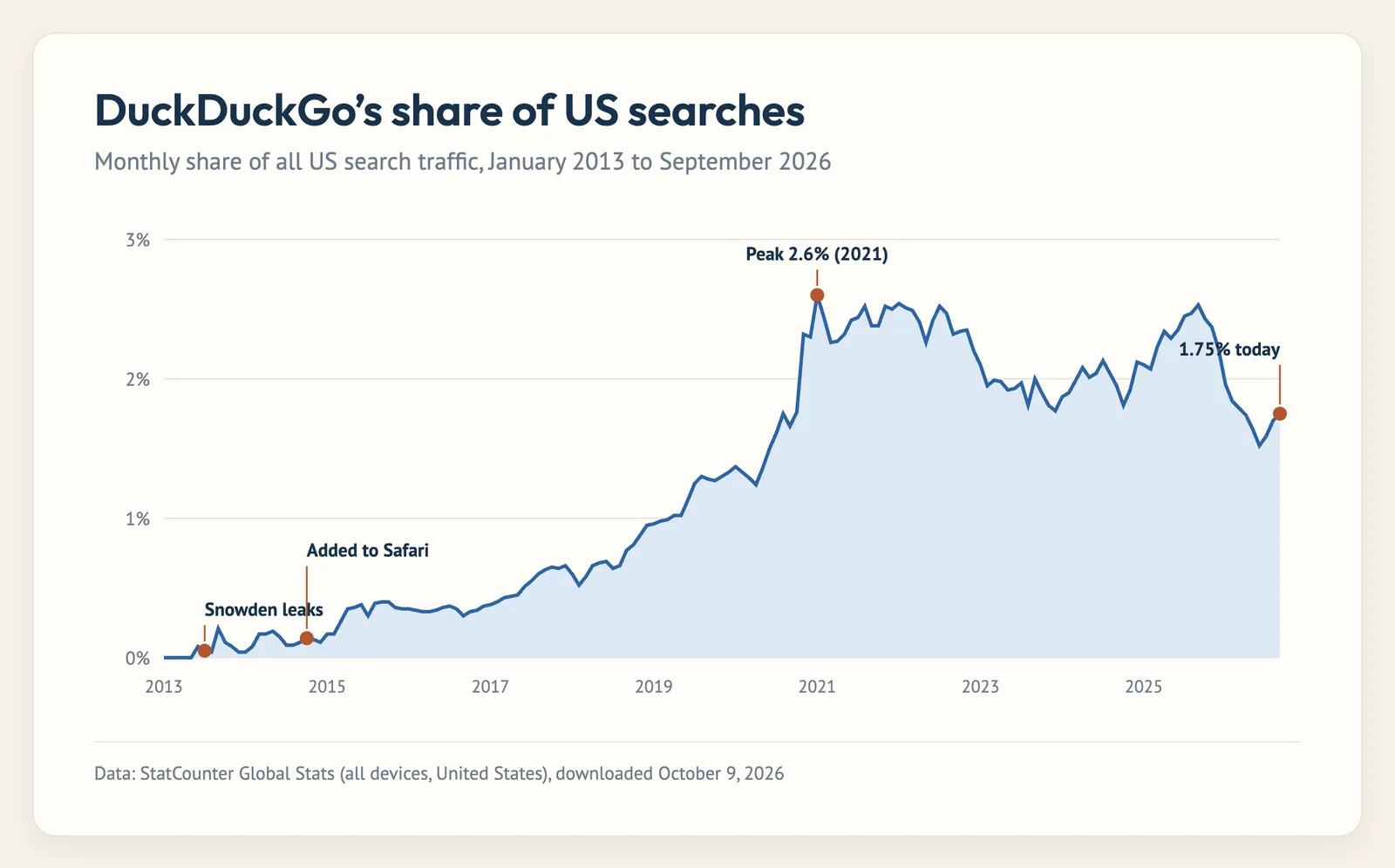
That said, it hasn’t translated into a bigger market share yet. StatCounter puts DuckDuckGo at 1.75% of US searches in September 2026, below its 2.6% peak in January 2021 and behind Google, Bing and Yahoo. For context, Google handles about 85%. DuckDuckGo is a strong niche player, not a Google killer.
DuckDuckGo vs Ecosia, Brave and Startpage
| Results from | Best for | Main trade-off | |
|---|---|---|---|
| DuckDuckGo | Mostly Bing | Strong privacy with zero effort | Ad clicks go through Microsoft; US company |
| Ecosia | Google or Bing | Funding climate projects with your searches | Keeps your IP for up to 7 days (details) |
| Brave Search | Its own independent index | Not depending on Big Tech at all | Index is younger; works best in the Brave browser |
| Startpage | Google-quality results, privately | Fewer extras; ad-supported the same way |
If you want your searches to do good, Ecosia is still my pick, and I’ve covered it in depth in my Ecosia review. If you want maximum privacy with the least effort, DuckDuckGo is the easiest choice. Privacy Guides, a well-respected independent privacy site, currently lists Brave Search first and DuckDuckGo second. I tested nine of them in the best private search engines.
The DuckDuckGo browser, Duck.ai and the subscription
DuckDuckGo now calls itself a browser company first. Its free browser is available on iPhone, Android, Mac and Windows, and includes:
- Tracker blocking on every site you visit, plus automatic cookie-banner handling.
- The Fire Button, which wipes your tabs and site data in one tap.
- Email Protection: free @duck.com forwarding addresses that strip trackers out of emails before they reach your real inbox.
- App Tracking Protection (Android), which blocks trackers inside your other apps.
- Duck Player, for watching YouTube without personalized ads.
Is Duck.ai private?
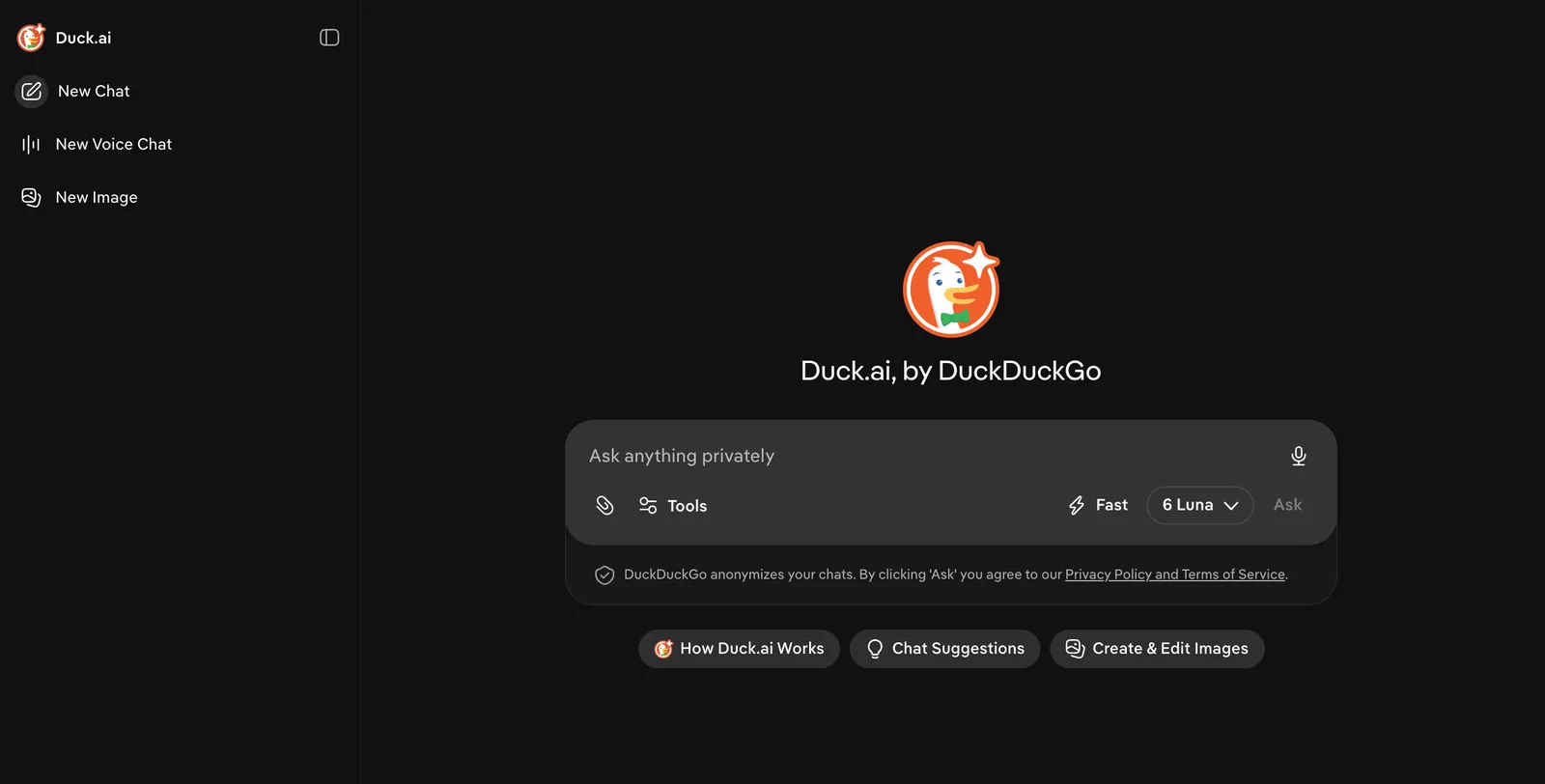
Duck.ai lets you use chatbots from companies like OpenAI, Anthropic and Mistral without an account. DuckDuckGo strips your IP address and other metadata, so requests “appear as though they are coming from DuckDuckGo,” and its agreements prohibit the AI companies from training on your chats. Chats are stored on your device by default. The fine print: depending on the model, providers may keep chats for up to 30 days for safety and legal reasons, and anything personal you type into the chat still reaches them. Treat it like any chatbot and don’t paste in sensitive information. I put all six free models through a hands-on test in my Duck.ai review.
Is the subscription worth it?
At $9.99 a month, the Plus plan is priced like a standalone VPN, and you get data-broker removal, identity theft help and premium AI models on top. If you were already going to pay for a VPN, it’s good value from a company with a better privacy record than most VPN brands. If you only want private search, you don’t need it. The search engine and browser are completely free.
How to make DuckDuckGo even more private
- Turn off ads in DuckDuckGo’s search settings. It’s the only way to close the Microsoft ad-click gap completely.
- Use the DuckDuckGo browser (or its extension) instead of just the search engine, so trackers are blocked on the sites you click through to.
- Turn off regional results if you don’t want your location used to localize results.
- Use the no-JavaScript version at html.duckduckgo.com, which skips the analytics pings I described above. When I tested it, it made zero analytics requests and set zero cookies.
- Use Tor or a VPN if you need to hide your IP address from DuckDuckGo itself.
My verdict on DuckDuckGo
What I like
- Zero cookies and no search history. My test backed up its main promise.
- A business model that doesn’t depend on knowing who you are.
- 18 years of track record, profitable, and $8 million donated to privacy causes.
- Results good enough that most people won’t notice they left Google.
- AI features are optional, unlike Google’s.
What gives me pause
- Most results come from Bing, so it depends heavily on Microsoft.
- Clicking an ad sends that click through Microsoft.
- Its no-logging claims have never been independently audited.
- The 2022 secret Microsoft deal, even though it was fixed.
- Local results are noticeably weaker than Google’s.
DuckDuckGo isn’t a scam, it isn’t secretly owned by Google, and in my testing it does what it says on the tin: it doesn’t follow you around. Its flaws are real but small, they’re mostly disclosed, and you can work around them. For the vast majority of people asking “should I switch from Google?”, my answer is yes, DuckDuckGo is a safe, legitimate and very usable choice. Keep !g handy for the occasional search it struggles with.
Have you switched to DuckDuckGo, or tried it and gone back to Google? Let me know in the comments. I read every one, just like I have on the Ecosia review since 2018.
DuckDuckGo FAQ
Is DuckDuckGo safe to use?
Yes. It doesn’t store your search history or IP address with your searches, it uses HTTPS encryption, and in my test it set zero cookies. The main exception is ad clicks, which pass through Microsoft’s ad network.
Does DuckDuckGo sell your data?
No. It says it doesn’t collect personal data to sell in the first place. It makes money from ads based on your current search, plus affiliate commissions and an optional subscription.
Is DuckDuckGo owned by Google?
No. DuckDuckGo is an independent private company based in Pennsylvania. The myth comes from the duck.com domain, which Google owned and redirected to Google until it transferred the domain to DuckDuckGo in 2018.
Can the police see my DuckDuckGo searches?
DuckDuckGo can be served with legal requests like any US company, but it says it can’t provide search histories linked to you because it doesn’t keep them. Your internet provider can see that you visited DuckDuckGo but not what you searched for.
Is DuckDuckGo better than Google?
For privacy, yes, by a wide margin. For search quality, Google is still better for local and very niche searches, while DuckDuckGo is just as good for most everyday searches.
Does DuckDuckGo use Bing?
Mostly, yes. In my 15-search test, 79% of DuckDuckGo’s top results also appeared in Bing’s top 10. It adds its own crawler, Apple Maps and other sources, and strips out the tracking.
Why does DuckDuckGo know my location?
It uses your IP address at the moment you search to show regional results. It says it doesn’t store your IP address with your search, and you can turn regional results off.
Is DuckDuckGo incognito?
Not exactly. Incognito mode stops your browser from saving history on your device, while DuckDuckGo stops the search engine from tracking you. They solve different problems, and using both together is more private than either alone.
Leave a Comment