
“Who owns DuckDuckGo?” gets searched thousands of times a month, and I get why. When a search engine promises not to track you, the next logical question is who’s behind it, and how do they get paid? If the answer were “a giant ad company” or “a foreign government,” that would change everything.
So I dug through DuckDuckGo’s own disclosures, its funding announcements, congressional testimony and court filings from the Google antitrust trial to piece together who actually owns it and where its money comes from.
The short answer: DuckDuckGo is owned by its founder and CEO, Gabriel Weinberg, along with a small group of investors and employees. It’s an independent private company in Pennsylvania. It is not owned by Google, Microsoft or anyone in China, and it makes its money mainly from ads based on what you search, not on who you are. Here are the details.
- Who owns DuckDuckGo?
- Gabriel Weinberg, founder and CEO
- DuckDuckGo’s investors
- Is DuckDuckGo owned by Google or Microsoft?
- Can you buy DuckDuckGo stock?
- How does DuckDuckGo make money?
- How much money does DuckDuckGo make?
- Where the money goes: donations and acquisitions
- Timeline
- FAQ
Who owns DuckDuckGo?
DuckDuckGo (officially Duck Duck Go, Inc.) is a privately held company headquartered in Paoli, Pennsylvania, outside Philadelphia. Its owners are:
- Gabriel Weinberg, who founded it in 2008 and is still CEO;
- venture and institutional investors, including Union Square Ventures, OMERS Ventures (a Canadian pension fund’s venture arm), Thrive Capital and GP Bullhound;
- individual investors, including web inventor Tim Berners-Lee and WhatsApp co-founder Brian Acton;
- employees, who have held shares (some cashed out in a 2020 share sale).
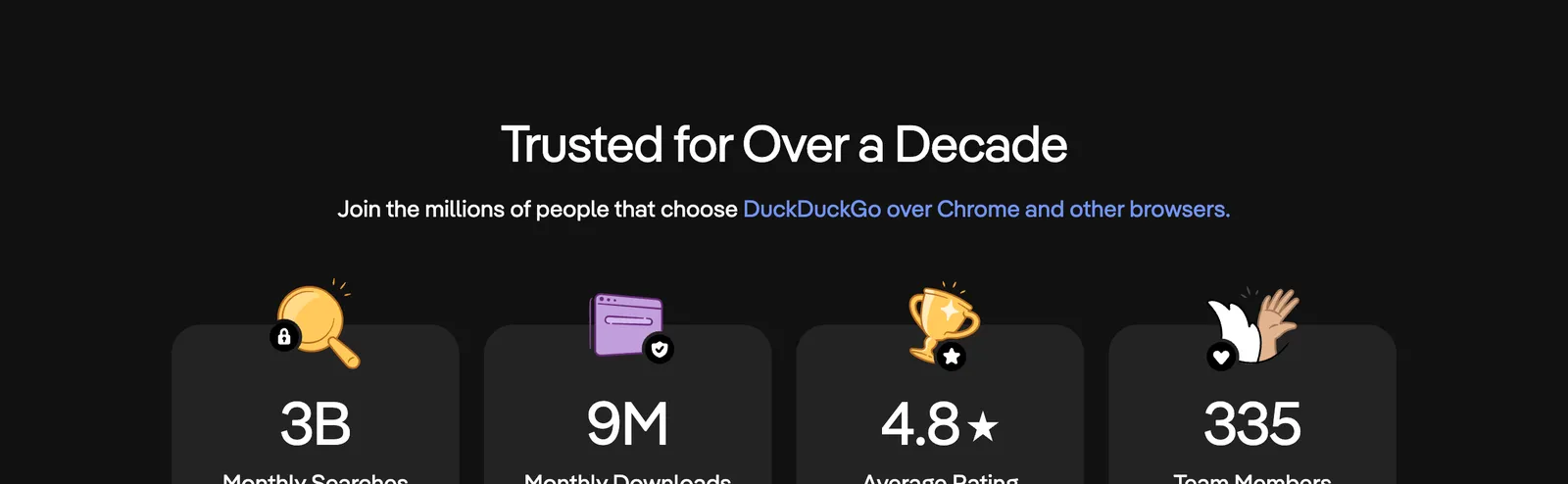
DuckDuckGo has never published an ownership breakdown or a valuation, so nobody outside the company knows exactly who owns what percentage. What we do know is that it has never been acquired, it isn’t a subsidiary of anyone, and it describes itself as “an independent company since our founding in 2008.” It has 335 employees spread across more than 15 countries and works fully remotely.
Gabriel Weinberg, founder and CEO
Weinberg is the main reason DuckDuckGo exists. His background:
- Education: studied physics (2001) and technology policy (2005) at MIT.
- First company: built the Names Database, a social network for reconnecting with old classmates, which United Online’s Classmates bought in March 2006 for about $10 million in cash.
- DuckDuckGo: launched September 25, 2008, from his basement near Philadelphia while he was a stay-at-home dad. He self-funded it for about three years and was its only full-time employee until late 2011.
- Author: co-wrote the startup marketing book Traction and Super Thinking, a book about mental models, with his wife, Lauren McCann.
- Public record: testified to the US Senate Judiciary Committee about privacy law in 2019 and was a witness in the US government’s antitrust trial against Google in 2023.
As of October 2026, he’s still running the company, and he remains one of Google’s loudest critics. After the judge’s 2025 remedies ruling in the antitrust case, he said Google would “still be allowed to continue to use its monopoly to hold back competitors.”
DuckDuckGo’s investors
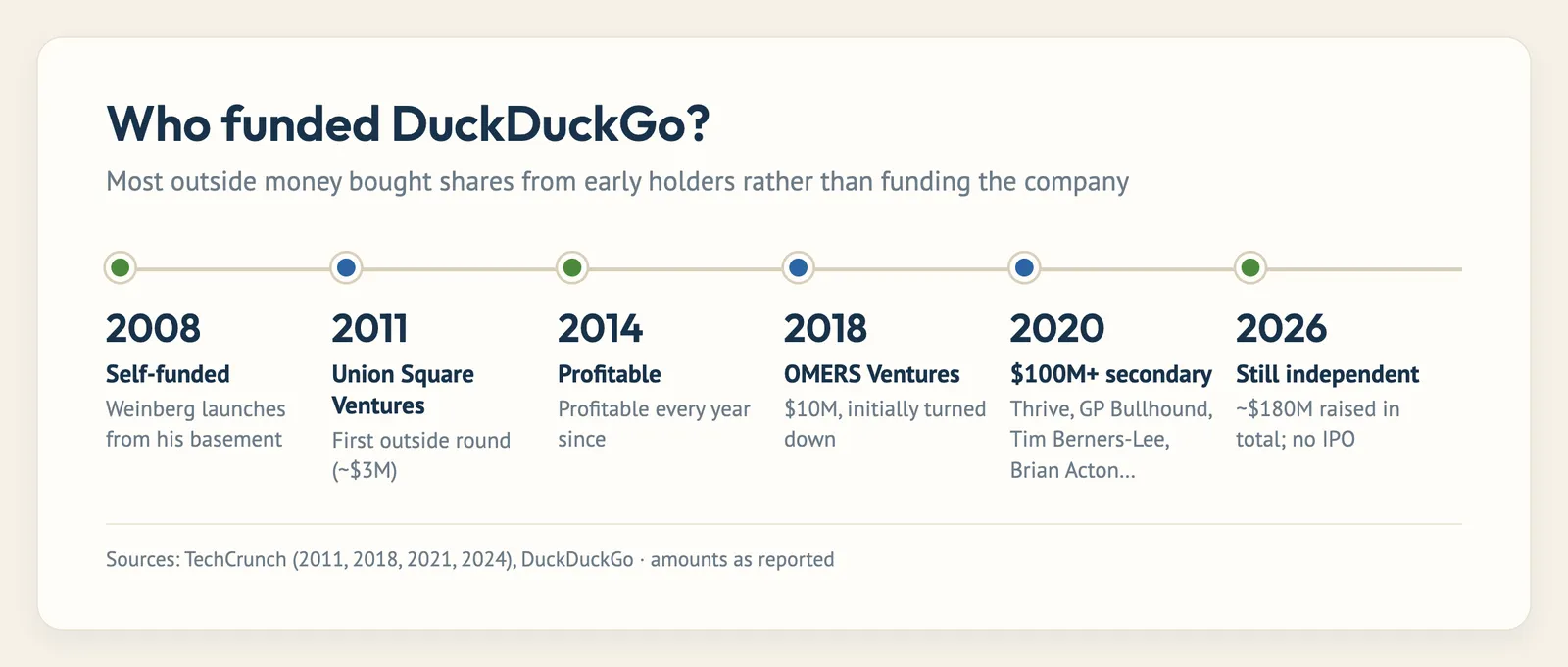
| Year | Round | Investors |
|---|---|---|
| 2008–2011 | Self-funded | Gabriel Weinberg |
| 2011 | First outside round (about $3M, undisclosed) | Union Square Ventures (early backer of Twitter and Tumblr) plus angel investors |
| 2018 | $10M | OMERS Ventures. DuckDuckGo initially turned it down because it didn’t need the money |
| 2020 | $100M+, mostly secondary | OMERS, Thrive Capital, GP Bullhound, Impact America Fund, Tim Berners-Lee, Brian Acton, Freada Kapor Klein and Mitch Kapor |
The important detail: most of that money was “secondary,” meaning investors bought shares from early employees and investors who wanted to cash out. It didn’t go into the company’s bank account. TechCrunch reported in 2024 that DuckDuckGo had raised around $180 million in total, “a fair chunk of it” secondary. In other words, DuckDuckGo has funded itself mostly through its own profits, not by burning investor cash, which means less pressure to cut privacy corners to hit growth targets.
Is DuckDuckGo owned by Google or Microsoft?
No to both.
- Google: the rumor comes from the domain duck.com. Google happened to own it for years (it came along with a 2010 acquisition), and typing duck.com used to redirect you to Google. Google transferred the domain to DuckDuckGo in December 2018. That was a domain handover, not a company sale. DuckDuckGo has spent the years since testifying against Google in court.
- Microsoft: DuckDuckGo has a business partnership with Microsoft. It licenses most of its search results and ads from Microsoft’s Bing. But Microsoft doesn’t own any part of DuckDuckGo. That partnership did cause a controversy in 2022, which I cover in my DuckDuckGo review.
- China or Russia: no. None of its investors are Chinese or Russian, and DuckDuckGo actually paused a partnership with Russia’s Yandex in 2022.
Can you buy DuckDuckGo stock?
No. DuckDuckGo is private, so there’s no DuckDuckGo stock, ticker symbol or IPO. As of October 2026 it hasn’t announced any plans to go public. The only ways to own a piece are being an employee or a private investor. Be wary of any website or app claiming to sell “DuckDuckGo shares.”
How does DuckDuckGo make money?
DuckDuckGo’s own help page puts it simply: “It is a myth that search engines need to track you to make money. The majority of our revenue is from private ads on our search engine.” It has three income streams:
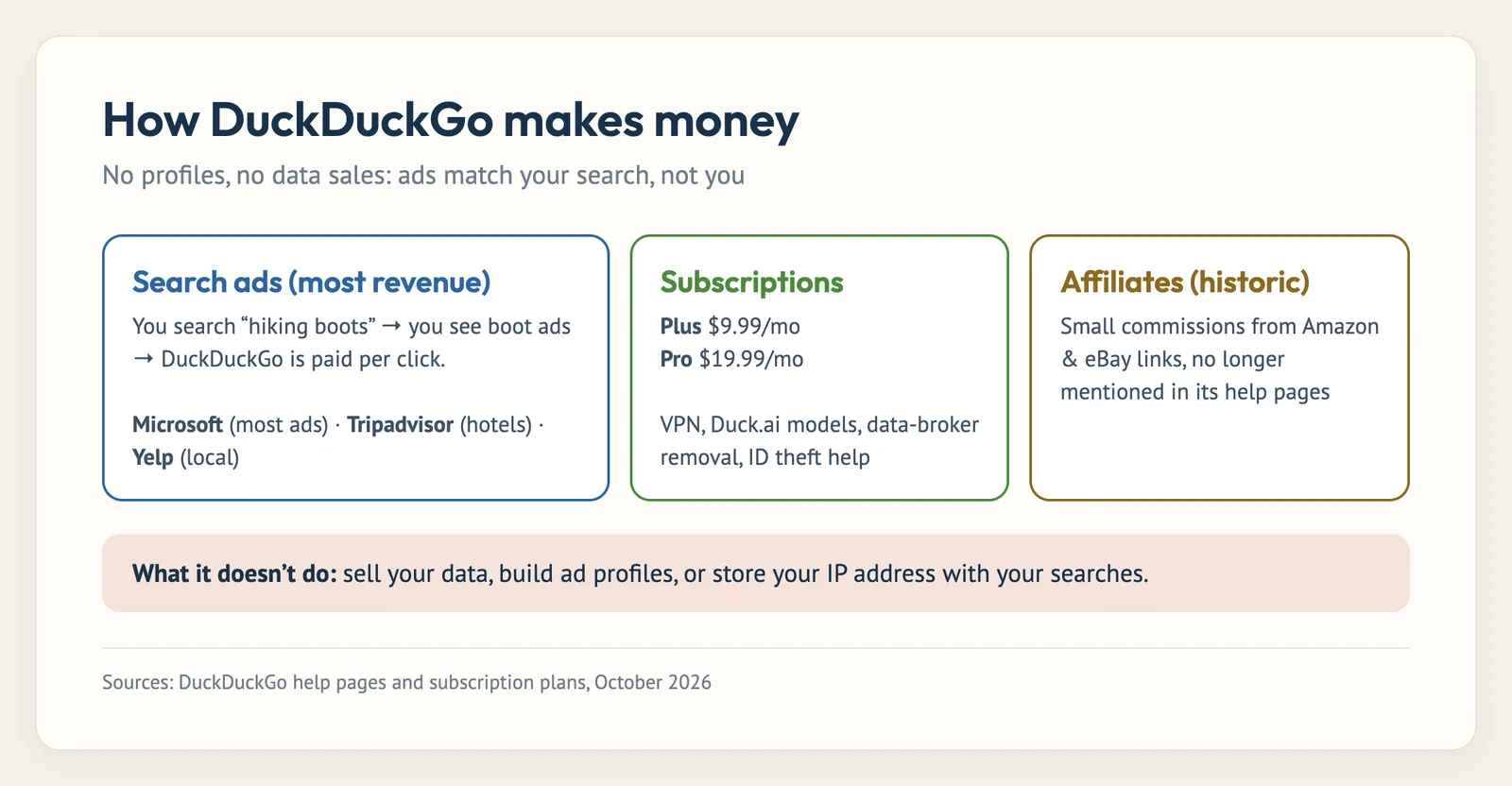
1. Contextual search ads (the big one)
When you search “hiking boots,” DuckDuckGo shows ads for hiking boots, and gets paid when you click one. That’s called contextual advertising: the ad matches your search, not your profile. Weinberg’s argument, which he made in a 2019 New York Times op-ed, is that this kind of advertising doesn’t need personal data to make money.
Most of the ads come from Microsoft Advertising, with hotel ads from Tripadvisor and local business ads from Yelp. A 2024 court filing in the Google antitrust case described Microsoft’s US search ads as DuckDuckGo’s main source of operating revenue. The trade-off is that when you click a Microsoft ad, Microsoft sees your IP address to bill the advertiser. I decoded a real ad link to show exactly how that works in is DuckDuckGo safe?
2. Subscriptions
Since 2024, DuckDuckGo has sold a paid subscription, originally called Privacy Pro. In 2026 it comes in two tiers:
| Plan | US price | Includes |
|---|---|---|
| Plus | $9.99/month or $99.99/year | VPN, advanced Duck.ai models, Personal Information Removal (US), Identity Theft Restoration |
| Pro | $19.99/month or $199.99/year | Everything in Plus, plus top AI models and higher usage limits (launched March 2026) |
It’s available in the US, UK, EU and Canada. This is DuckDuckGo’s attempt to reduce its dependence on ads, and on Microsoft.
3. Affiliate links (historically)
DuckDuckGo used to earn small commissions through non-tracking affiliate programs with Amazon and eBay. Its current help pages no longer mention affiliates, so this appears to be a minor or discontinued source today.
What about my data?
It doesn’t sell it. Because DuckDuckGo doesn’t build profiles or store your IP address with your searches, there’s no personal data to sell. That’s the whole pitch.
How much money does DuckDuckGo make?
As a private company, DuckDuckGo doesn’t publish its financials, but here’s what’s on the record:
- 2011: about $115,000 in revenue, when it had three employees.
- 2014: became profitable, and says it has been profitable every year since. Weinberg repeated that under oath to the US Senate in 2019.
- 2019: revenue “substantially more than” $25 million, per that Senate testimony.
- 2020–2021: ad revenue passed $100 million a year, according to Weinberg.
There’s no official figure newer than that. Any website quoting a precise number for 2025 or 2026 is guessing. For perspective, Google earned $224.5 billion from search ads in 2025. DuckDuckGo is a profitable niche business, not a Google rival in size.
Where the money goes: donations and acquisitions
Unlike Ecosia, which publishes where every dollar goes, DuckDuckGo isn’t a nonprofit or a social enterprise. It’s a regular company that keeps its profits. But it does give a slice away every year to privacy and digital-rights organizations:
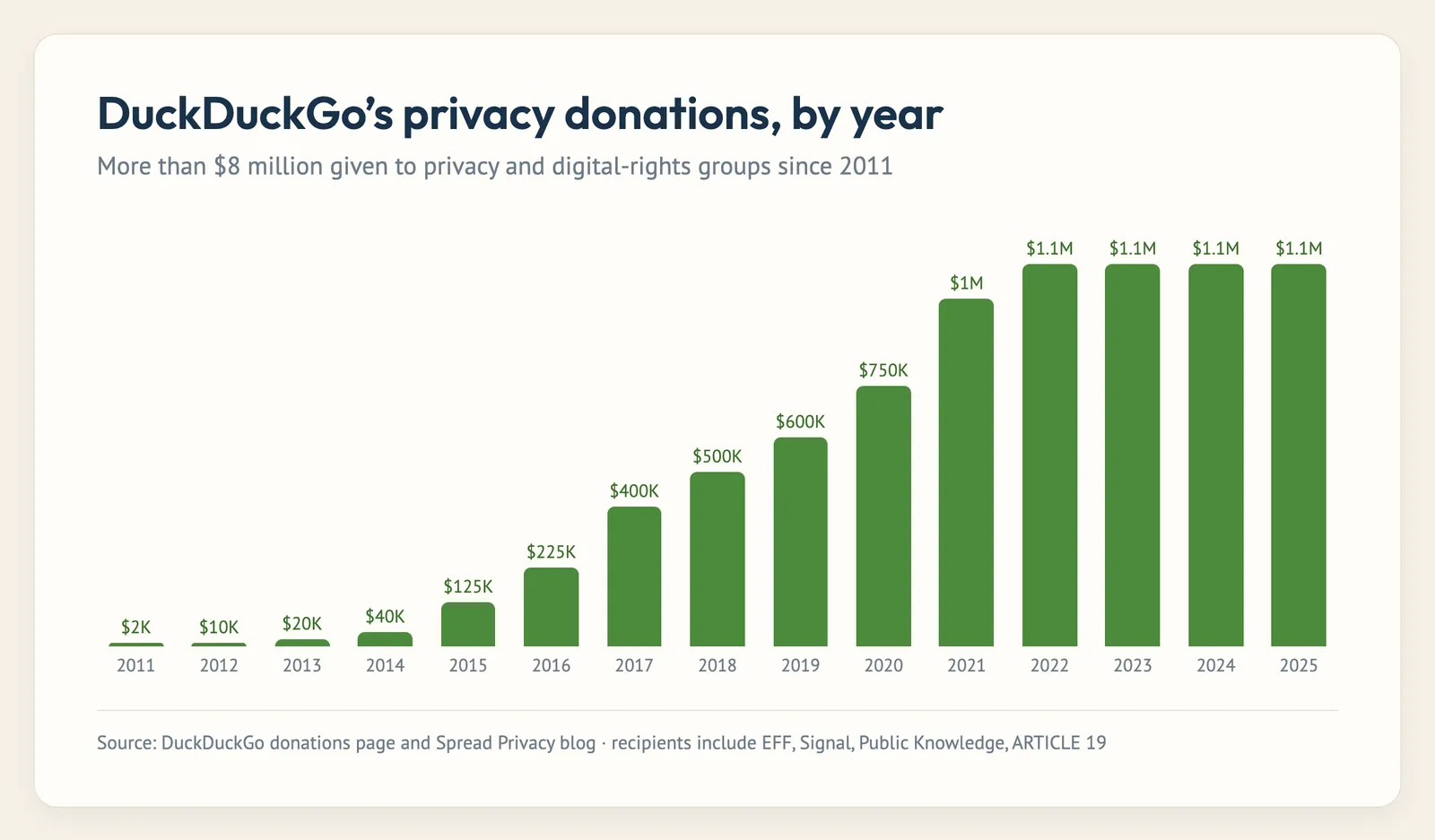
It has given $1.1 million a year since 2022 and more than $8 million since 2011, to groups like the Electronic Frontier Foundation, Signal, Public Knowledge and ARTICLE 19. It also invests in other privacy startups: it bought the data-removal company Removaly in 2022 (which now powers its Personal Information Removal feature) and joined You.com’s $50 million funding round in 2024.
DuckDuckGo timeline
- 2006: Weinberg sells the Names Database for about $10M.
- 2008: DuckDuckGo launches on September 25.
- 2011: Billboard in San Francisco: “Google tracks you. We don’t.” Union Square Ventures invests.
- 2013: Traffic doubles after Edward Snowden’s surveillance leaks.
- 2014: Becomes profitable; added as a search option in Apple’s Safari.
- 2016: Becomes the default search engine in the Tor Browser.
- 2018: $10M from OMERS; Google hands over the duck.com domain.
- 2020: $100M+ secondary investment.
- 2022: Microsoft tracker controversy; launches its desktop browser.
- 2023: Weinberg testifies in the US v. Google antitrust trial.
- 2024: Launches its subscription and Duck.ai.
- 2026: Launches the Pro plan; 3 billion searches a month.
For my take on whether all this adds up to a company you can trust, read my full DuckDuckGo review.
FAQ
Who owns DuckDuckGo?
Founder and CEO Gabriel Weinberg, plus investors including Union Square Ventures, OMERS Ventures, Thrive Capital and Tim Berners-Lee, and employees. It’s an independent private company.
Who is the CEO of DuckDuckGo?
Gabriel Weinberg, who founded the company in 2008 and has led it ever since.
Where is DuckDuckGo based?
Paoli, Pennsylvania, near Philadelphia. Most of its 335 employees work remotely from more than 15 countries.
Is DuckDuckGo owned by Google?
No. The confusion comes from the duck.com domain, which Google owned until 2018. DuckDuckGo is independent and is one of Google’s biggest critics.
Is DuckDuckGo a public company?
No. It’s privately held, so you can’t buy DuckDuckGo stock.
How does DuckDuckGo make money without tracking?
Mostly from contextual ads that match your search instead of your profile, plus Plus and Pro subscriptions.
Is DuckDuckGo profitable?
Yes. It says it has been profitable since 2014, with revenue above $100 million a year since around 2020.
Leave a Comment