
Google is still the 8-gazillion-pound gorilla of search. It handles about 85% of US searches and nearly 90% worldwide. DuckDuckGo is the scrappy privacy alternative that keeps coming up whenever someone gets creeped out by an ad that knows a little too much. So which one should you actually use?
I’ve used both for years, and for this comparison I ran them side by side: the same searches in fresh browsers, a count of every cookie each one set, a look at what each shows you first, and a check of where DuckDuckGo’s results really come from.
The short answer: DuckDuckGo is better for privacy by a mile, and it’s good enough for most everyday searches. Google is still better for local results, very niche questions and anything brand new. Most people can switch to DuckDuckGo and use a two-character shortcut for the occasional search where Google wins. Here’s the full comparison.
- DuckDuckGo vs Google at a glance
- Privacy: what each one knows about you
- Search results: is DuckDuckGo as good as Google?
- AI answers: on by default vs optional
- Ads: what pays the bills
- Features compared
- Is DuckDuckGo better than Google?
- How to switch (and keep Google as a backup)
- FAQ
DuckDuckGo vs Google at a glance
| DuckDuckGo | Winner | ||
|---|---|---|---|
| Tracking | None; 0 cookies in my test | Search history + ad profile; 5 cookies | DuckDuckGo |
| Search history | Not saved | Saved to your account (auto-deletes after 18 months by default for new accounts) | DuckDuckGo |
| Everyday results | Very good (mostly Bing) | Excellent | Google, slightly |
| Local results and maps | Apple Maps; thinner reviews | Google Maps; best in class | |
| AI answers | Short AI summary on some searches; can be set to Never, or use the AI-free version | AI Overviews can’t be turned off | DuckDuckGo |
| Ads | Based on your search only | Based on your search and your profile | DuckDuckGo |
| Shortcuts | !bangs to 13,500+ sites | None | DuckDuckGo |
| Extras | Tracker-blocking browser, Duck.ai, email protection | Huge ecosystem (Gmail, Maps, YouTube…) | Depends on you |
Privacy: what each one knows about you
This is where the two are night and day, so I measured it. I opened a brand-new Chrome profile for each, searched “best hiking boots” without accepting any cookie banners, and logged every cookie:
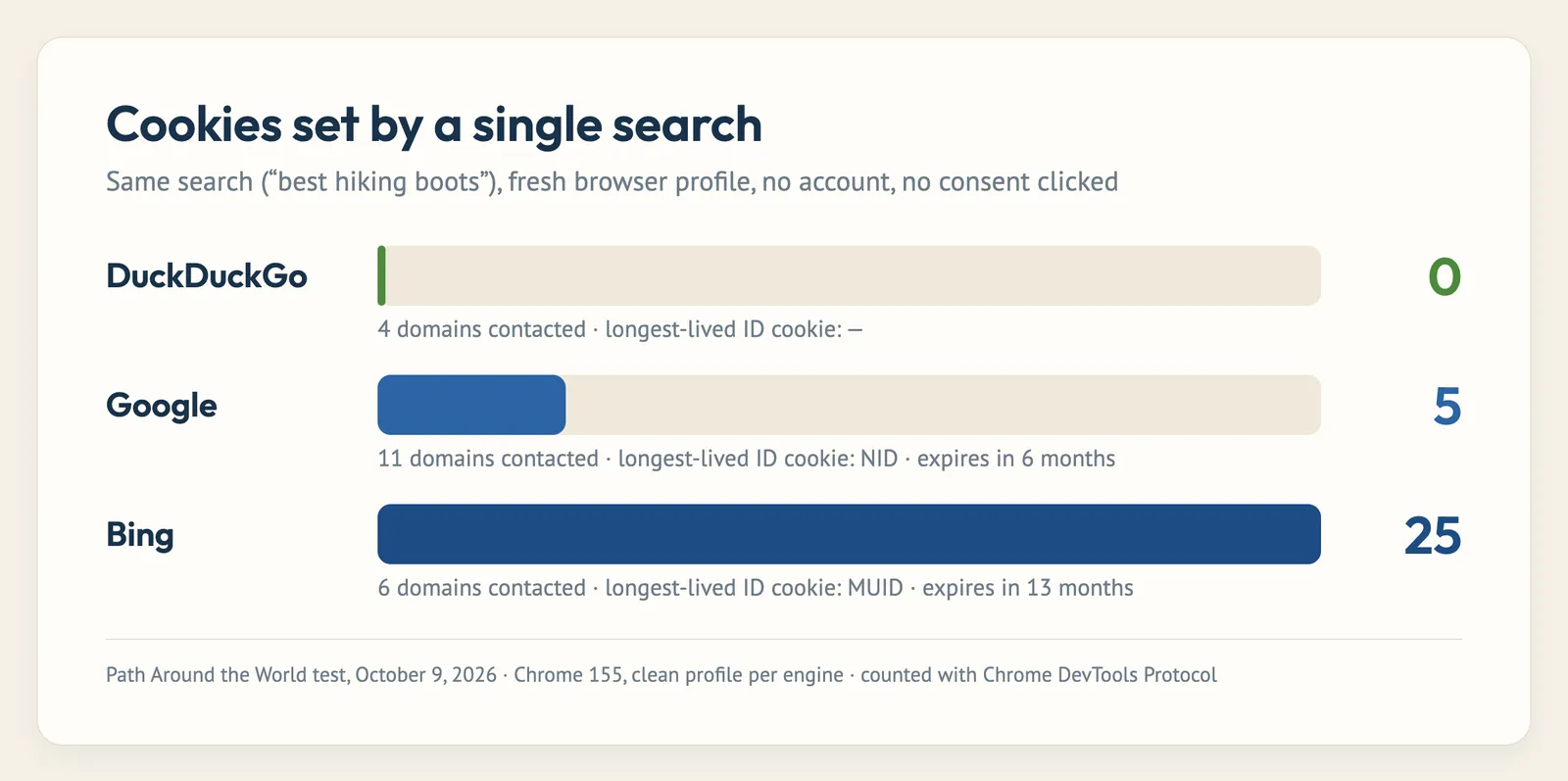
DuckDuckGo set zero cookies. Google set five, including its NID ID cookie, which lasts six months, and the page loaded Google Tag Manager and Google’s ad services. I repeated the test later the same day and got identical numbers.
Here’s what that means in practice:
| What happens to your searches | DuckDuckGo | |
|---|---|---|
| Linked to you? | No. No account, no ID cookie | Yes. To your Google account, or to a cookie ID if signed out |
| Used to personalize ads? | No | Yes, unless you turn off personalized ads in My Ad Center |
| How long kept? | Not kept with your identity at all | Search history: 18 months by default for accounts created since 2020 (you can choose 3 or 36 months, or off). Ad server logs: part of your IP removed after 9 months, cookie info after 18 |
| Can websites see your search? | No. Only “duckduckgo.com” | No, but Google itself keeps it |
| Private in incognito? | Yes, either way | Not really. Google agreed in 2024 to destroy billions of records it collected from Incognito users to settle a lawsuit |
Google is upfront about all of this in its privacy policy. Its own example is that searching for “mountain bikes” can get you sports equipment ads on YouTube. It just isn’t what most people expect. Google’s Search & other ads earned it $224.5 billion in 2025, and knowing who you are is a big part of why those ads work so well.
DuckDuckGo isn’t perfectly invisible either. Clicking one of its ads routes you through Microsoft’s ad network, and its no-tracking promise hasn’t been independently audited. I go through all of that (with proof) in is DuckDuckGo safe?
Search results: is DuckDuckGo as good as Google?
For most searches, honestly, yes. DuckDuckGo gets most of its regular results from Microsoft Bing. When I compared 15 searches, 79% of DuckDuckGo’s top-10 results also appeared in Bing’s top 10. So the real question is “Bing vs Google,” plus DuckDuckGo’s own extras like Wikipedia boxes and Apple Maps.
Here’s where I notice a difference day to day:
- Everyday stuff (recipes, how-tos, definitions, news, Wikipedia-style questions): basically a tie. I rarely miss Google.
- Local searches (“coffee near me,” opening hours, reviews): Google wins clearly. Google Maps has more businesses, more reviews and more accurate hours than the Apple Maps data DuckDuckGo uses. As a traveler, this is where I feel it most.
- Very niche or brand-new topics: Google’s index is bigger and fresher, so it usually finds the obscure forum post or the article published an hour ago first.
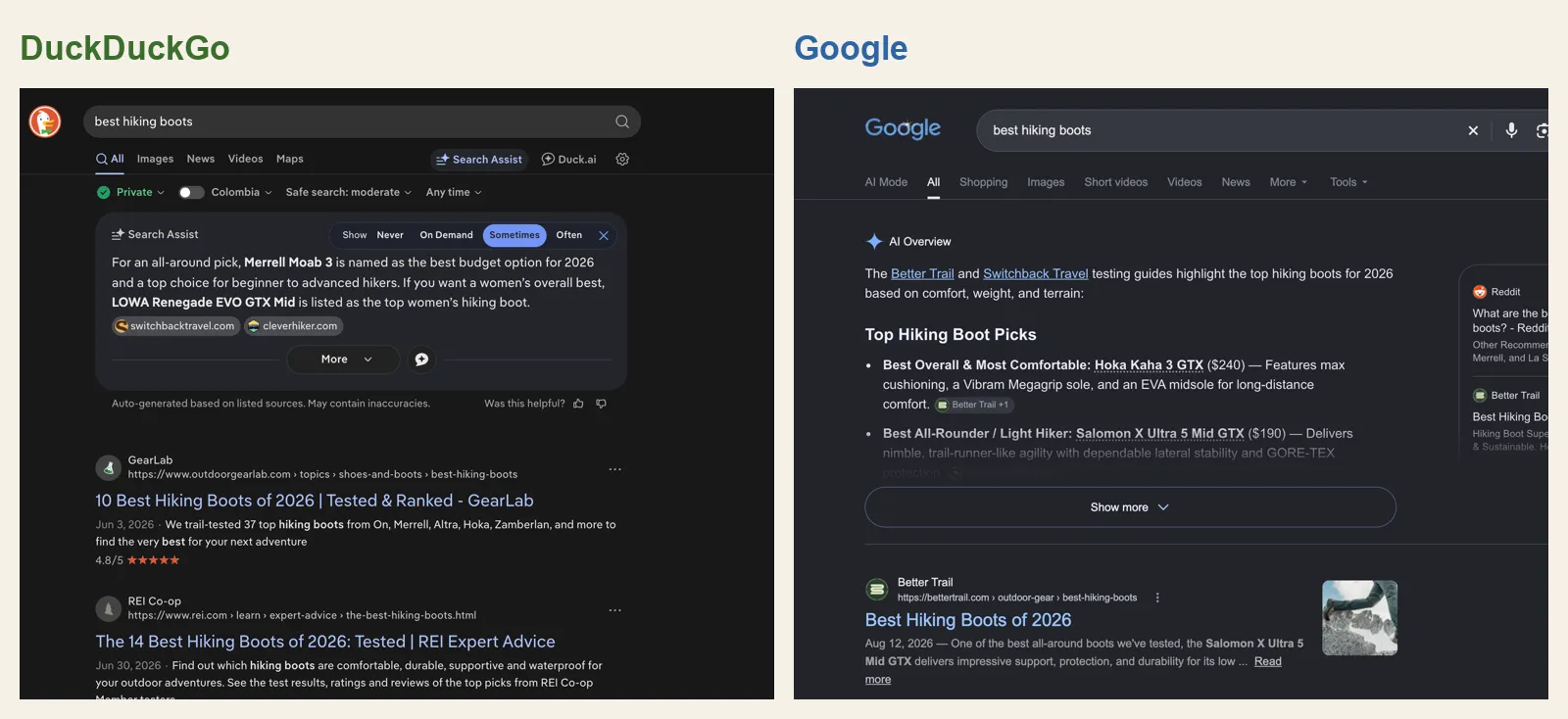
- Shopping and commercial searches: both are cluttered with ads and affiliate “best of” lists. For “best hiking boots,” both put something above the real results: DuckDuckGo showed either three ads or a short AI summary depending on the run, while Google led with a big AI Overview.
DuckDuckGo’s secret weapon for the gaps is !bangs: type !g in front of any search to send just that one search to Google, !m for Google Maps, !w for Wikipedia or !a for Amazon. You only give up privacy for that single search.
AI answers: on by default vs optional
This has become one of the biggest differences between them in 2026.
Google now puts AI front and center. Its AI Overviews appear above the regular results (they were the first thing on my “best hiking boots” search), and at its I/O conference in May 2026 Google called its AI-powered search box “the biggest upgrade to our Search box in over 25 years.” Google’s help page is clear that AI Overviews are a core feature that can’t be turned off. Your only workaround is clicking the “Web” filter, or adding &udm=14 to a Google search URL, to get plain links.
DuckDuckGo makes AI optional. To be fair, it does show its own short AI summary, called Search Assist, on some searches by default (you can see one at the top of my screenshot above). But there’s a setting right on the summary to switch it to “Never,” and its AI answers (and its Duck.ai chat) can be turned down or off in settings, and it runs an entirely AI-free version at noai.duckduckgo.com. When DuckDuckGo polled its users in early 2026, about 90% of voters said they didn’t want AI in search, and DuckDuckGo says visits to its no-AI page tripled after Google’s May announcement.
If AI answers drive you nuts, this alone might be reason enough to switch.
Ads: what pays the bills
Both companies are paid by advertisers, but in very different ways:
- Google uses what you search for plus what it knows about you (your account activity, YouTube history, location and more) unless you turn personalization off.
- DuckDuckGo only uses what you just typed. Search for “hiking boots” and you get boot ads. That’s it. Most of its ads come from Microsoft, plus Tripadvisor for hotels and Yelp for local businesses. You can even switch ads off entirely in settings.
How DuckDuckGo turns that into a profitable business is a story of its own, which I cover in who owns DuckDuckGo and how it makes money.
Features compared
| Feature | DuckDuckGo | |
|---|---|---|
| Image, video and news search | Yes | Yes |
| Maps | Apple Maps | Google Maps |
| Instant answers (weather, calculator, conversions) | Yes | Yes, more of them |
| AI chat | Duck.ai (anonymous, no account) | Gemini / AI Mode (can be saved to your Google activity) |
| Safe Search for kids | Strict / Moderate / Off | Filter / Blur / Off |
| Shortcuts to other sites | !bangs | No |
| Own browser | DuckDuckGo browser (blocks trackers) | Chrome |
| Works without an account | Everything | Search yes; most extras need sign-in |
Is DuckDuckGo better than Google?
It depends on what “better” means to you:
- Choose DuckDuckGo if you care about privacy, you’re tired of AI answers and creepy ads, and most of your searches are everyday questions. That’s most people, in my experience.
- Stick with Google if you rely heavily on local search, you live inside Google’s ecosystem and like the personalization, or your work depends on finding very obscure information fast.
Personally, I use DuckDuckGo as my default and type !g maybe once or twice a week, usually for a restaurant or business abroad. That combo gives me 95% of Google’s usefulness with a fraction of the tracking. And if you’re wondering whether to trust DuckDuckGo as a company, my full DuckDuckGo review digs into its founder, investors and controversies.
How to switch (and keep Google as a backup)
- On a computer: go to your browser’s settings, find “Search engine,” and pick DuckDuckGo. It’s built into Chrome, Safari, Firefox and Edge.
- On iPhone: Settings → Apps → Safari → Search Engine → DuckDuckGo.
- On Android: open Chrome → Settings → Search engine → DuckDuckGo, or install the DuckDuckGo browser.
- Keep Google one shortcut away: add
!gto any search when you need it. - Give it two weeks. The first few days feel different. After that, most people stop noticing.
Want to compare more than just these two? I tested nine search engines in the best private search engines.
DuckDuckGo vs Google FAQ
Is DuckDuckGo better than Google?
For privacy, yes, clearly. For search quality, Google is still a little better overall and much better for local results, but DuckDuckGo is just as good for most everyday searches.
Is DuckDuckGo safer than Google?
Yes, for privacy. DuckDuckGo set zero cookies in my test and doesn’t keep your search history, while Google links searches to your account or a cookie ID and uses them for ads.
Does DuckDuckGo use Google?
No. DuckDuckGo gets most of its results from Microsoft Bing, plus its own crawler and sources like Apple Maps and Wikipedia. You can send a single search to Google with the !g shortcut.
Why is DuckDuckGo worse than Google for some searches?
Mainly local results and very new or niche topics, where Google’s bigger index and Google Maps data have the edge.
Can I turn off Google’s AI Overviews?
Not completely. Google says AI Overviews can’t be turned off, but the “Web” filter (or &udm=14 in the URL) shows results without them. DuckDuckGo lets you turn AI off entirely.
Is DuckDuckGo owned by Google?
No. DuckDuckGo is an independent company in Pennsylvania. See who owns DuckDuckGo for the full story.
Leave a Comment