
I’ve been writing about alternative search engines on this site since 2018, starting with my Ecosia review, and the most common follow-up question is always: “OK, but which one is actually the most private?”
Most “best private search engine” lists just repeat each company’s marketing. So I did something different. I ran the same search on nine search engines, each in a brand-new browser with no history or cookies, and recorded every cookie and every outside server each one contacted. Then I dug into who owns each engine, where its results really come from, and what its privacy policy says it keeps.
My quick picks: DuckDuckGo is the best private search engine for most people, Brave Search is the best if you want independence from Google and Microsoft, and Startpage is the best if you want Google’s results without Google. Here’s the full breakdown.
- Quick picks
- My test: 9 search engines, 1 search
- Comparison table
- 1. DuckDuckGo
- 2. Brave Search
- 3. Startpage
- 4. Mojeek
- 5. Kagi
- 6. SearXNG
- 7. Ecosia
- 8. Qwant
- Best private search engine without AI
- How to choose
- FAQ
Quick picks
- Best overall: DuckDuckGo. Zero cookies in my test, great results, free, and easy for anyone.
- Most independent: Brave Search. Zero cookies, and it uses its own index instead of renting Google’s or Bing’s.
- Google results, privately: Startpage. A Dutch company that passes your search to Google anonymously.
- Best paid option: Kagi. No ads at all, and very good results, from $5 a month.
- Most private if you’re technical: SearXNG. Run it yourself and nobody else holds your searches.
- Best for doing good: Ecosia. Not the most private, but its profits fund climate projects.
One engine you’ll still see on older lists is Mullvad Leta. Mullvad shut it down in November 2025, so I haven’t included it.
My test: 9 search engines, 1 search
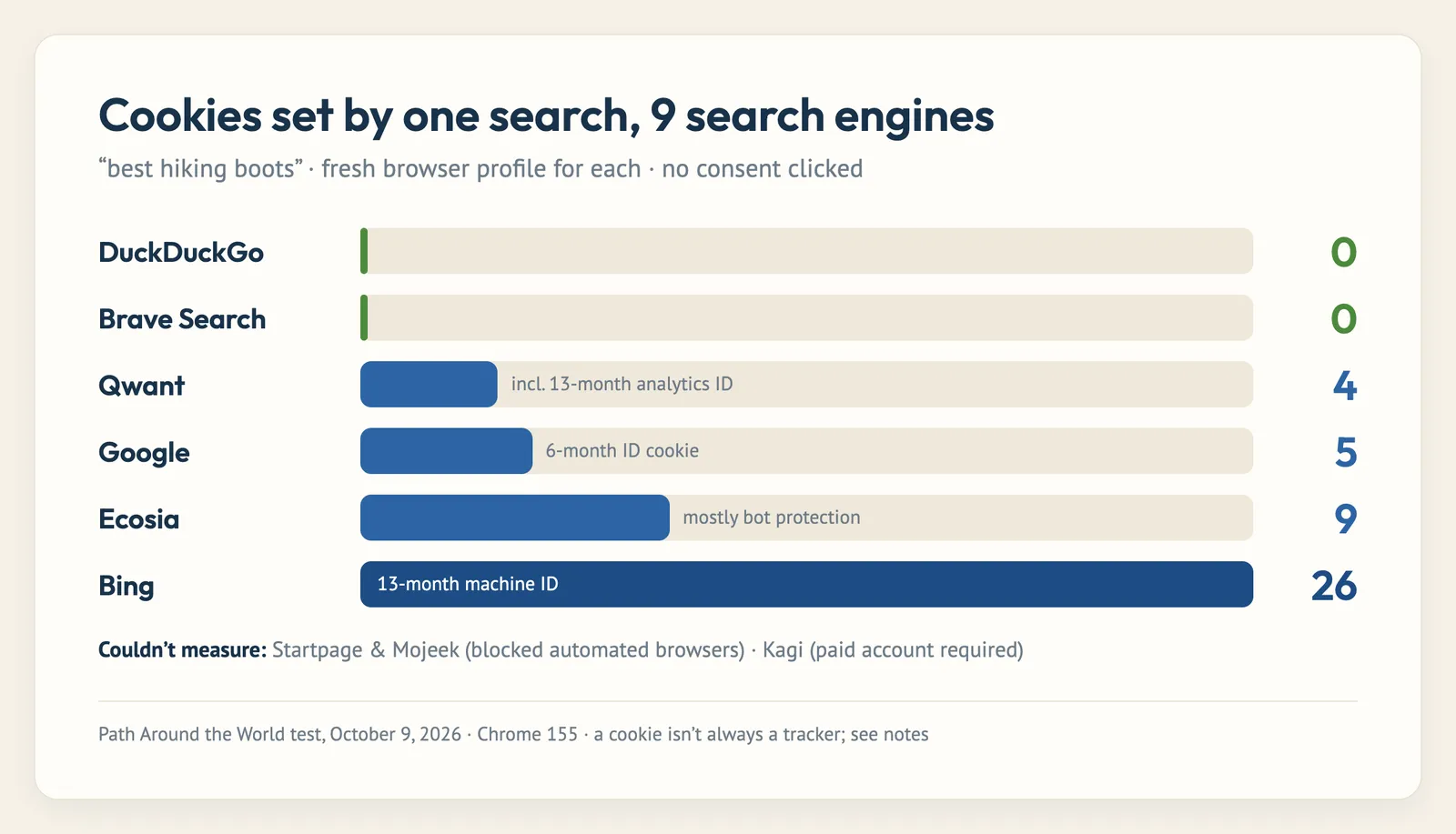
On October 9, 2026, I searched for “best hiking boots” on each engine. Every engine got its own fresh Chrome profile (no history, no cookies, no account), and I didn’t click any cookie banners. I logged every cookie and every server the page talked to.
| Search engine | Cookies set | Lasting 30+ days | What I noticed |
|---|---|---|---|
| DuckDuckGo | 0 | 0 | Only contacted its own servers |
| Brave Search | 0 | 0 | Only contacted its own servers |
| Qwant | 4 | 3 | Includes a 13-month analytics visitor ID and a bot-protection cookie |
| 5 | 3 | 6-month ID cookie, Google Tag Manager, AI Overview at the top | |
| Ecosia | 9 | 5 | Mostly bot-protection (Cloudflare, DataDome) and settings cookies |
| Bing | 26 | 9 | 13-month machine ID; contacted Microsoft login servers |
| Startpage | Blocked my automated test with a bot check (it set 2 short-lived challenge cookies) | ||
| Mojeek | Blocked my automated search (403 error); its homepage set 0 cookies | ||
| Kagi | Requires a paid account, so it sent me to a login page | ||
A quick word of caution on reading this: a cookie isn’t automatically a tracker. Some are just for remembering your settings or keeping bots out. Ecosia’s cookies, for example, are mostly bot protection, not ad tracking. But the two engines that set no cookies at all, DuckDuckGo and Brave, are the gold standard here, and Bing setting 26 cookies on one search tells you a lot about Microsoft’s priorities. For the full methodology on the DuckDuckGo side, see is DuckDuckGo safe?
Private search engines compared
| Results from | Based in | Price | AI by default? | Privacy Guides pick? | |
|---|---|---|---|---|---|
| DuckDuckGo | Mostly Bing + own sources | USA | Free (ads) | Sometimes; easy to switch off, no-AI version available | Yes |
| Brave Search | Own index | USA | Free (ads) or $3/mo ad-free | Yes, can be turned off | Yes (listed first) |
| Startpage | Google (+ Bing) | Netherlands | Free (ads) | None that I found | Yes |
| Mojeek | Own index | UK | Free (ads) | Offers AI summaries | No |
| Kagi | Own indexes + major providers | USA | From $5/mo | Opt-in | No |
| SearXNG | Many engines combined | Wherever you host it | Free | No | Yes |
| Ecosia | Google or Bing + EU index | Germany | Free (ads fund trees) | Yes (AI Overviews) | No |
| Qwant | Bing + own EU index | France | Free (ads) | Unclear | No |
Privacy Guides, a respected independent privacy site, currently recommends Brave Search, DuckDuckGo, Startpage and SearXNG (as of May 2026).
1. DuckDuckGo: best private search engine for most people
DuckDuckGo is the one I recommend to friends and family, because it’s private and effortless. In my test it set zero cookies and talked only to its own servers. Its policy says it doesn’t save your search history or store your IP address with your searches, and it hides your search terms from the websites you click.
- Results: mostly from Microsoft Bing. In my 15-search comparison, 79% of its top results matched Bing’s. They’re good for everyday searches, but weaker than Google for local businesses.
- Extras: “!bangs” shortcuts to 13,500+ sites, a free tracker-blocking browser, and Duck.ai for private AI chat.
- Watch out for: clicking its ads sends that one click through Microsoft’s ad network. You can turn ads off in settings.
Full details are in my DuckDuckGo review and DuckDuckGo vs Google comparison.
2. Brave Search: best independent private search engine
Brave Search, from the company behind the Brave browser, tied DuckDuckGo in my test with zero cookies. Its big selling point is that it runs on its own index of the web rather than renting results from Google or Bing. Brave says that index covers more than 40 billion pages. That makes it one of the very few truly independent search engines.
- Privacy: Brave’s policy says IP addresses are deleted within seconds and it doesn’t retain them; it keeps de-identified query data (query, country, language, platform) that isn’t grouped by user.
- Price: free with private ads, or Search Premium for $3 a month to remove ads (Brave browser only).
- Watch out for: “Answer with AI” is on by default for many questions. You can switch it off in settings, but it’s stored in a cookie, so clearing cookies turns it back on. Privacy Guides also suggests turning off Brave’s anonymous usage metrics.
- Who’s behind it: Brave Software, co-founded by Brendan Eich, the creator of JavaScript and co-founder of Mozilla.
3. Startpage: Google results without Google tracking
If DuckDuckGo’s Bing-based results leave you wanting, Startpage is the answer. It sends your search to Google anonymously and shows you Google’s results, so Google sees the search but not you.
- Privacy: “We don’t log your searches,” and it doesn’t record your IP address except to block abusive bots. Being in the Netherlands, data requests have to come through Dutch courts.
- Watch out for: since 2019, a majority stake has been owned by System1, an American ad-tech company. Startpage says its founders can veto any change that would hurt privacy, and Privacy Guides was satisfied with its answers, but it’s worth knowing. System1 still reports Startpage as one of its properties in 2026.
- Test note: Startpage blocked my automated browser with a bot check, so I couldn’t measure it the same way. That’s an anti-bot measure, not a privacy red flag.
4. Mojeek: the underdog with its own index
Mojeek is a small British search engine that has been building its own crawler since 2004 and now indexes around 9 billion pages. It’s refreshingly simple: no tracking, and its privacy policy says IP addresses aren’t recorded (they’re replaced with a country code).
- Best for: people who want a genuinely independent, non-Big-Tech search engine and don’t mind rougher results.
- Watch out for: results can be hit or miss for niche or very new topics, and it blocked my automated search test.
5. Kagi: best paid search engine
Kagi flips the model completely: you pay, so there are no ads at all. Plans start at $5 a month for 300 searches, $10 a month for unlimited, and $25 a month with premium AI models. There’s a free trial of 100 searches.
- Privacy: its policy says searches are only logged temporarily for debugging and it doesn’t track which results you click. It even supports Privacy Pass so you can search without linking searches to your account.
- Results: excellent, mixing its own small indexes with anonymized calls to major search providers.
- Watch out for: you need an account (which is why my test hit a login page), and Kagi has faced criticism for using Russia’s Yandex as one of its result sources.
6. SearXNG: most private for tech-savvy users
SearXNG isn’t a company. It’s free, open-source software that combines results from dozens of search engines without tracking you. If you run it on your own server, nobody but you ever holds your search history.
- Best for: people comfortable self-hosting.
- Watch out for: public SearXNG sites are run by strangers with their own policies, and they’re often rate-limited or blocked by Google and Bing.
7. Ecosia: best for the planet (but not the most private)
You know I’m a fan of Ecosia. Its profits fund tree planting and climate projects, and I’ve tracked its finances for years in my Ecosia review. But in my test it set 9 cookies (mostly bot protection), its AI Overviews are on by default, and it keeps your IP address for up to 7 days before anonymizing it. That’s still far better than Google, but not in DuckDuckGo’s league.
If you’re torn between the two, I break down the trade-offs in is Ecosia safe? and in the DuckDuckGo vs Ecosia section of my DuckDuckGo review. Ecosia is also building its own European search index with Qwant, which could make it more independent over time.
8. Qwant: the French option
Qwant is a French search engine now owned by the founders of the cloud company OVHcloud, together with France’s public investment bank. It uses its own index plus Microsoft Bing.
- Privacy: without your consent it stores only a salted hash of your IP address and processes searches pseudonymously. But if you accept personalized ads, Microsoft can keep your full IP address for 6 months.
- Watch out for: in my test it set a 13-month analytics visitor ID cookie. That’s first-party analytics, not ad tracking, but it’s more than DuckDuckGo or Brave set.
Best private search engine without AI
A lot of people now want a search engine without AI answers, especially since Google made AI the centerpiece of search in May 2026. Your best options:
- DuckDuckGo’s no-AI search at noai.duckduckgo.com: DuckDuckGo’s results with every AI feature switched off. DuckDuckGo says visits tripled after Google’s AI announcement.
- Startpage: I couldn’t find any AI answer feature in its product or privacy policy.
- Mojeek: a classic list of links from its own index. It has added AI summaries, but it also campaigns against using web content to train AI.
And if you’re sticking with Google, its “Web” filter (or adding &udm=14 to the search URL) shows plain links without AI Overviews. I cover that in DuckDuckGo vs Google.
How to choose the right private search engine
- Want it easy? DuckDuckGo. Set it as your default and forget about it.
- Want independence from Big Tech? Brave Search or Mojeek, which both run their own index.
- Can’t give up Google’s results? Startpage.
- Hate ads and don’t mind paying? Kagi.
- Want total control? Self-host SearXNG.
- Want your searches to do good? Ecosia.
Whichever you pick, remember a private search engine only protects your searches. Pair it with a privacy-focused browser, and a VPN if you need to hide your IP address.
Private search engine FAQ
What is the most private search engine?
For most people, DuckDuckGo or Brave Search. Both set zero cookies in my test and don’t keep search histories. A self-hosted SearXNG is the most private of all, but it takes technical setup.
Is there a search engine that doesn’t track you?
Yes. DuckDuckGo, Brave Search, Startpage and Mojeek all say they don’t track you or store your searches with your identity. DuckDuckGo and Brave set no cookies at all in my test.
What is the best alternative to Google search?
DuckDuckGo is the easiest switch for most people. If you specifically want Google’s results without the tracking, use Startpage.
Are private search engines really private?
Mostly, but no search engine is independently audited, so you’re trusting their policies. They also don’t hide your IP address from the websites you visit. For that you need a VPN or Tor.
Is DuckDuckGo or Brave Search more private?
They tied in my cookie test. Brave has the edge on independence with its own index, while DuckDuckGo has the edge on simplicity and makes AI answers easier to switch off.
Is Ecosia a private search engine?
It’s more private than Google, but less private than DuckDuckGo or Brave. It anonymizes IP addresses within 7 days and set 9 cookies in my test. See is Ecosia safe?
Leave a Comment